
Weave selected by the duty
From coarse scalping decks to micron-rated filter packs, the weave follows the opening, the pressure and the cleaning method. Hook or tension edges are fitted at our works so panels tension onto the deck without reworking on site.
- A
Plain weave
Wire interlaced over-under in equal diameters. Open, accurate and easy to clean — the default for fine sizing, sand and dewatering duty.
- B
Twill weave
Successive wires offset, allowing finer wires and tighter cloth under higher pressure. Used for finer filtration where plain weave would be too open.
- C
Lock crimp / pre-crimped
Wires crimped before weaving so apertures lock in place under impact. For coarse scalping where a plain weave would distort.
- D
Dutch weave
Heavy warp with fine weft for dense, pressure-resistant filter cloth. Fine and ultra-fine filtration down to micron rating on request.
- E
Hook & tension edge
Panels supplied with welded hooks or reinforced edges so they tension onto the deck without reworking — replacement parts, not raw cloth.
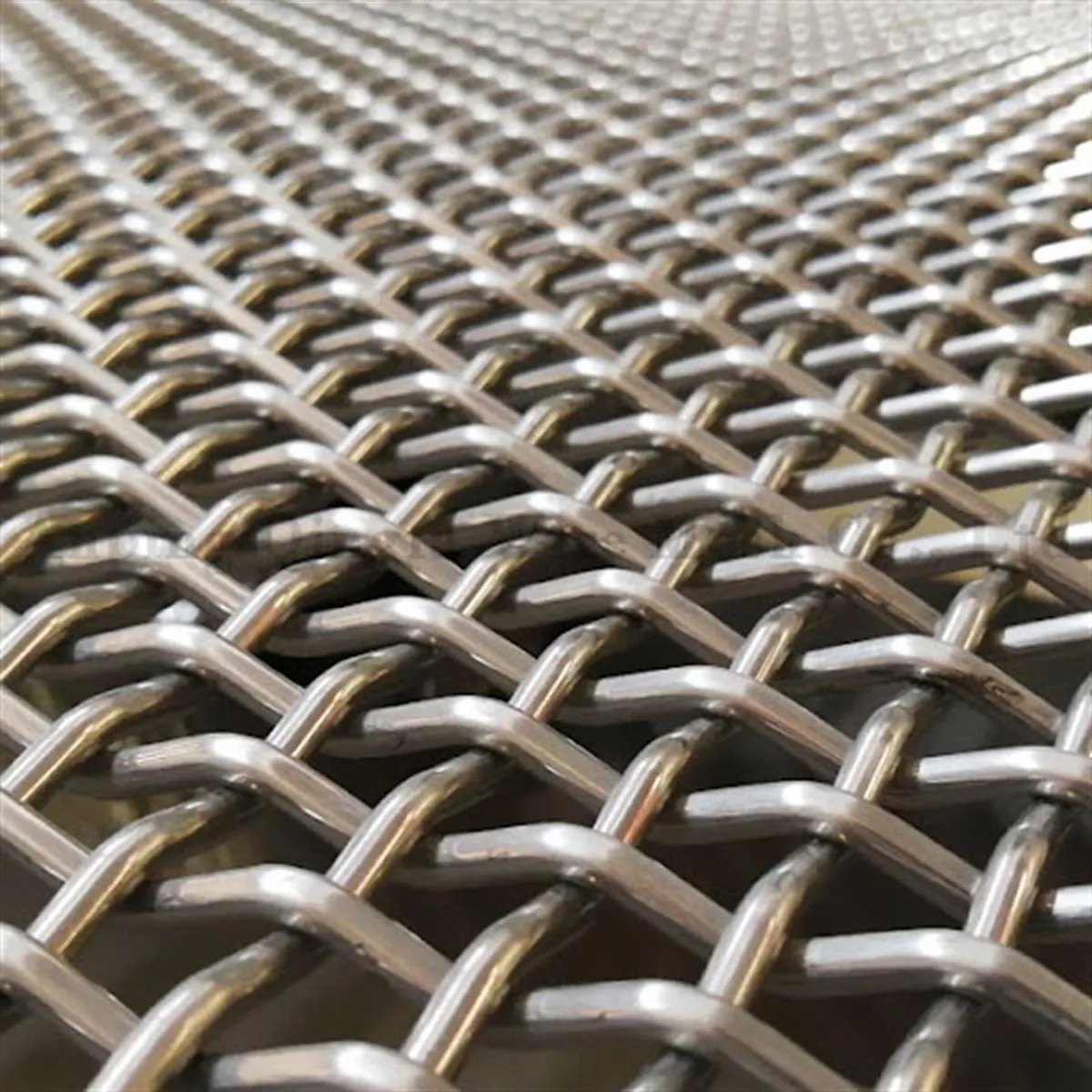 Screen mesh · stainless, pre-crimped weave
Crimped and woven cloth, coarse to micron rating
Two cloth types are listed below: pre-crimped and lock-crimped wire for vibrating decks, scalping and aggregate sizing (aperture 3–60 mm, heavier wire for abrasive and impact-heavy feed); and plain, twill and Dutch woven cloth from 1 to 400 mesh down to micron rating for filtration and straining.
| Aperture mm | Wire dia mm | Weave / crimp | Open area | Recommended duty |
|---|---|---|---|---|
| 3 | 1.5 | Plain weave | 44% | Fine sizing, sand, dewatering fines |
| 5 | 2.0 | Plain weave | 51% | Sizing 3–5 mm aggregate |
| 10 | 2.5 | Plain / pre-crimped | 64% | Aggregate sizing |
| 20 | 3.5 | Lock crimp | 72% | Coarse sizing, scalping |
| 40 | 5.0 | Lock crimp | 79% | Primary scalping |
| 60 | 6.0 | Flat top | 83% | Quarry primary, heavy scalping |
| Mesh / inch | Wire dia mm | Aperture mm | Typical duty |
|---|---|---|---|
| 2 | 1.80 | 10.90 | Coarse guards, coarse filtration, strainers |
| 4 | 1.20 | 5.15 | General sizing, process strainers |
| 8 | 0.60 | 2.58 | Fine guards, liquid/gas filtration |
| 20 | 0.30 | 0.97 | Process filtration, polymer screens |
| 60 | 0.15 | 0.273 | Fine filtration, water treatment |
| 120 | 0.08 | 0.132 | Precision filtration, spin-pack screens |
| 200 | 0.063 | 0.064 | Micron-rated filtration |
| 400 | 0.025 | 0.039 | Ultra-fine filtration; Dutch weave on request |
Open area for square aperture calculated as (a / (a + d))² × 100, where a = aperture and d = wire diameter. Fine weave apertures are quoted as mesh count and micron rating; exact opening and flow rate are confirmed on the quotation. Tolerances: aperture ±3% on woven cloth; wire diameter to ISO 781 / ASTM A580. Finish: mill as standard; electropolished or pickled on request. Grade certificates (EN 10204 3.1, heat number traceable) per batch; third-party inspection (SGS, BV, PSI) on request.
Grade for the screen duty
304
EN 1.4301Dry guarding, general sizing and atmospheric filtration; cost-effective general purpose.
316
EN 1.4401Wet duty, water and wastewater, wash-down and chloride exposure; the usual filtration grade.
321
EN 1.4541High-temperature screens and heat-cycle service where welded cloth must resist intergranular corrosion.
347
EN 1.4550Niobium-stabilized high-temperature and welded cloth; resists intergranular corrosion after welding and heat cycling.
Monel 400
UNS N04400Seawater, hydrofluoric acid, alkali and reducing-acid filters; marine and chemical processing.
2205 Duplex
EN 1.4462Heavy abrasive screening and coastal duty where high wear meets chloride pitting risk.
ASTM E2016 / ISO 9044
Industrial woven wire cloth — aperture tolerance, weave and inspection rules, whether the cloth filters, guards or screens.
ASTM A580 / GB/T 4240
Stainless steel wire — the wire behind the weave, tested for diameter and tensile per heat.
EN 10088-2
Grades 1.4301 (304), 1.4401 (316), 1.4541 (321), 1.4550 (347), 1.4462 (2205); Monel 400 per UNS N04400 — composition and corrosion class.
EN 10204 3.1
Mill test certificates with heat-number traceability — supplied with every screen order.
Weave selection by duty
| Duty | Start with |
|---|---|
| Filtration & straining | Fine plain weave, 316, electropolished for clean-down; finer apertures quoted on request |
| Fine sizing 3–5 mm | Plain weave, 316 for wet duty |
| 5 – 20 mm | Plain or pre-crimped, 10–20 mm aperture |
| 20 – 60 mm | Lock crimp, 304 or 2205 wire |
| Guards & heavy duty | Heavy pre-crimped or flat-top, 50 mm and up, 304 heavy wire |
Filtration, guarding and screening duty
| Industry | Duty | Main challenge | Recommended screen |
|---|---|---|---|
| Petrochemical & refining | Catalyst retention, packing support, line strainers | Fine aperture, corrosion, temperature | Fine plain weave, 316 or 321, electropolished |
| Polymer & fibre spinning | Melt and spin-pack filtration | Pressure, cleanliness, no fibre snag | Fine plain/Dutch weave, 316, electropolished, no loose wire |
| Water & wastewater | Screening, filter-media support | Wet, biofouling | Plain weave 3–10 mm, 316 |
| Chemical & fertilizer | Sizing, screening, drying trays | Corrosion, temperature | 316 plain weave, 321 or Monel 400 for hot/acid duty |
| Heavy industry & machine guarding | Perimeter guards, walkways, enclosures | Impact, visibility, load | Heavy pre-crimped or flat-top 25–50 mm, 304 heavy wire |
| Quarry & aggregate | Crushed stone sizing 5–40 mm | Wire wear, pegging | Pre-crimped lock crimp 10–40 mm, 304 or 2205 |
| Sand & gravel washing | Classification, dewatering | Blinding on fines | Plain weave 3–5 mm, 316, hook edge |
| Mineral processing & C&D | Scalping, oversize removal | Heavy impact, sharp shapes | Heavy wire 5–8 mm, 316 or 2205 duplex |
| Marine & seawater | Intake screens, strainers, guards | Seawater chloride, biofouling | Monel 400 weave or 2205 duplex, hook edge |
Send us the particle size.
Tell us what passes, the environment and the flow — we will recommend aperture, weave, wire and grade, and quote within one working day.